
Every student learns differently, yet traditional teaching methods often fail to address this reality. With classrooms filled with learners who have unique strengths, challenges, and interests, it’s clear that a one-size-fits-all approach is no longer sufficient. Differentiated learning offers a dynamic solution, allowing educators to adapt their teaching strategies to meet the needs of each student.
By customising lessons, activities, and assessments, this approach keeps every learner engaged—whether they need additional support or thrive on advanced challenges. Apart from engagement, differentiated learning fosters inclusivity, enhances academic performance, and builds confidence in students as they progress respectively.
How does this personalised learning strategy empower educators to create more engaging and effective classroom environments for students to excel academically? Let’s find out in this article.
Understanding Differentiated Learning
Key Elements of Differentiated Learning
1. What is Differentiated Learning?
Differentiated learning is an educational philosophy that recognises the uniqueness of every student. By tailoring instruction to accommodate varying needs, strengths, and learning preferences, the approach ensures that each student has the opportunity to thrive. With this approach, students can learn in a way that aligns with their interests and abilities. As a result, it promotes deeper engagement and better academic outcomes.
2. Key Elements of Differentiated Learning
Differentiated learning revolves around three key elements: content, process, and product. These components work together to develop an inclusive learning experience where all students can ace their studies.
-
Content: Varying What Students Learn
Differentiated learning begins with adapting the content delivered to students. Teachers may modify the depth, breadth, or focus of the material to align with each learner’s readiness, interests, or prior knowledge. For instance, advanced learners might explore more complex topics or participate in independent research. Meanwhile, those needing additional support may focus on foundational concepts. This adaptive teaching method provides multiple entry points to the curriculum, enabling students to learn at their own pace.
-
Process: Adjusting How Students Engage with Material
The process of learning is just as important as the material itself. Differentiated instruction involves using a variety of methods and resources to help students interact with the content in ways that suit their learning styles.
Visual learners might benefit from diagrams and videos, while kinesthetic learners may engage better through hands-on activities or experiments. Small group discussions, peer collaboration, and one-on-one guidance are other effective strategies that enable students to process information in a way that resonates with them.

-
Product: Offering Diverse Ways to Demonstrate Learning
In a differentiated classroom, students have the flexibility to showcase their understanding through various formats. Some may prefer creating projects or delivering presentations, while others might opt for traditional tests or written assignments. This flexibility not only accommodates learning style diversity but also encourages creativity and critical thinking. When students are allowed to choose how they demonstrate their learning, teachers are able to foster a sense of ownership and pride in their achievements.
Together, these three elements—content, process, and product—form the foundation of differentiated learning. They provide a roadmap for educators to develop personalised learning experiences that support students’ journey towards academic success.
3. The Need for Differentiation
Traditional education methods often operate under the assumption that all students learn in the same way, at the same pace. While this uniform approach is convenient for standardised instruction, it fails to account for the diverse abilities, interests, and learning styles present in any classroom. The result is that some students may struggle to keep up whereas others may become disengaged due to a lack of challenge.
Differentiated learning addresses these limitations by shifting the focus from a “one-size-fits-all” model to a personalised approach. As part of the process, each student is deemed to be unique, and inclusive education practices are used to make all learners feel involved. Whether it’s providing extra scaffolding for those who need it or offering advanced tasks to challenge high achievers, differentiation not only improves students’ engagement but also boosts better academic outcomes. Overall, it paves the way for a more effective and equitable education.
4. Common Learning Styles
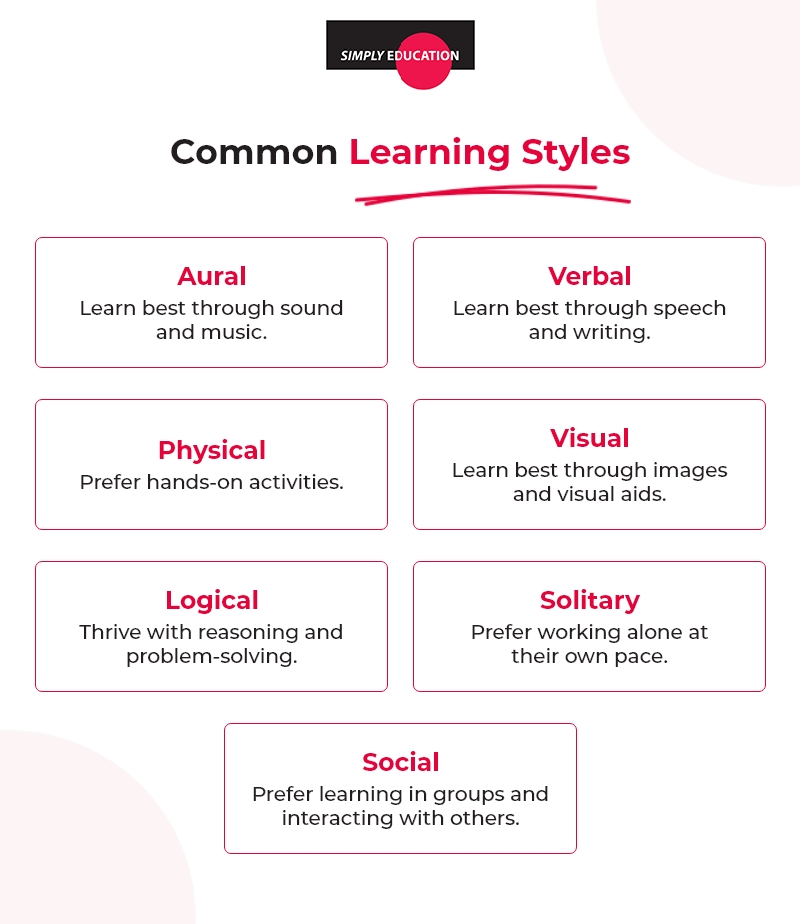
Understanding the different ways students learn is essential for implementing differentiated instruction. As each student has a preferred way of processing and retaining information, arranging suitable lessons helps accommodate these preferences to ensure enriching learning experiences. Below are the most common learning styles and their characteristics:
-
Aural Learners
Aural learners absorb information best through sound and music. They thrive in environments where they can listen to lectures, participate in discussions, or use rhythmic patterns to memorise concepts. Incorporating audio resources like podcasts, songs, or verbal storytelling can greatly benefit these learners.
-
Verbal Learners
Verbal learners excel through speech and writing. They enjoy activities that involve reading, writing essays, or participating in debates. These students stand out when engaged in structured discussions and written assignments, and other opportunities that enable them to express their thoughts through speaking or writing
-
Physical Learners
Also known as kinesthetic learners, physical learners prefer hands-on activities and learn by doing. They are most motivated when they can interact with their surroundings, such as through experiments, role-playing, or building models. Adding movement or tactile experiences to lessons can make learning more meaningful for them.
-
Visual Learners
Visual learners process information best through images, diagrams, and other visual aids. They are drawn to charts, graphs, and illustrations that help them visualise concepts. Teachers can support these learners through infographics, videos, or visual presentations to convey information.
-
Logical Learners
Logical learners are driven by reasoning and problem-solving, especially in subjects like mathematics and science. They work best with patterns, data, and logical sequences. Providing them with puzzles, analytical challenges, or opportunities to apply critical thinking can enhance their learning experience.
-
Solitary Learners
Instead of benefitting from collaborative classroom techniques, solitary learners perform better when they work independently. To help these learners excel, educators should create quiet environments for them to focus on their tasks. They may also consider assigning self-paced projects or allocating independent study time.
-
Social Learners
Group settings are a natural fit for social learners, who excel through collaboration, discussions, and interactive activities. Offering opportunities for teamwork, peer feedback, and shared learning experiences may capture their interest and contribute to an exciting learning process.
Benefits of Differentiated Learning
Now that we have explored the foundations and key elements of differentiated learning, this section will delve into its numerous benefits. Let’s uncover their role in transforming the experiences of both learners and educators.
1. Increased Student Engagement
One key benefit of differentiated learning is its ability to captivate students’ interest. Prioritising a sense of autonomy and ownership, the concept encourages learners to take an active role in their progress. It aims to boost students’ enthusiasm for learning by developing a more participatory learning setting.
2. Catering to Diverse Learning Styles
Every student has a unique way of absorbing and processing information. Differentiated learning recognises these differences by addressing a wide range of learning styles, such as visual, auditory, kinesthetic, and reading/writing preferences. This adaptability engages all students meaningfully with learning materials, regardless of their cognitive abilities or prior knowledge.
3. Promoting Inclusive Education
Inclusivity is more important than ever in today’s diverse classrooms, building students’ confidence and encouraging collaboration among their peers. Differentiated learning supports students with varying abilities through customised strategies. This student-centred learning approach helps to break down barriers to learning, ensuring that every student is valued as they work towards academic success.
4. Improved Academic Outcomes
The ultimate goal of any teaching approach is to enhance academic performance, and differentiated learning plays a part in this regard. To help students develop a stronger understanding and retention of concepts, this technique often incorporates learning materials that are relevant to students’ preferences, laying a solid foundation for lifelong learning.
Differentiated Learning: Moving Away From Uniformity
How Differentiated Learning Works in Practice
After exploring the key benefits of differentiated learning, we will now learn how this approach works in practice. This methodology can be implemented in various ways within the classroom. Here’s how:
1. Small Work Groups
One of the core strategies in differentiated learning is the use of small work groups. In this setting, students are rotated through different groups to interact with different peers and gain diverse perspectives. These groups can range from pairs to larger teams, depending on the task at hand.
By working together, students are able to collaborate, share ideas, and learn from one another. On top of fostering a sense of community within the classroom, this approach also encourages peer-to-peer teaching, where stronger students can help those who may need additional support. The flexibility in group size ensures that all students contribute meaningfully to the learning process.
2. Reciprocal Learning
Reciprocal learning is another powerful technique used in differentiated instruction. In this method, students take turns acting as teachers, sharing their knowledge with their peers and asking questions to reinforce their understanding. This approach empowers students by giving them ownership of their learning.
As they explain concepts to others, they deepen their comprehension and solidify the material in their minds. Moreover, the act of teaching encourages active engagement and critical thinking, as students must process the information and present it in a way that others can understand.
3. Continual Assessment
In a differentiated classroom, assessment is not limited to periodic exams or tests. Instead, teachers engage in continual assessment, using both formal and informal methods to monitor student progress. This ongoing evaluation allows teachers to identify students’ strengths and pinpoint areas that may need improvement.
Through regular check-ins, quizzes, and observational assessments, teachers can adjust their teaching strategies to better meet the needs of individual students. As teachers can quickly respond to learning gaps and provide targeted support, continual assessment ensures that no student falls behind during the lessons.

Overcoming Challenges in Implementing Differentiated Learning
Building on the practical strategies of differentiated learning, we now turn our attention to some of the challenges that educators may face when implementing this approach. While differentiated instruction is beneficial, it also requires careful planning, resources, and support. In this section, we will identify the common obstacles teachers encounter and provide practical solutions to overcome them.
1. Teacher Preparedness
-
Challenge: Professional Development
One of the primary challenges in implementing differentiated learning is keeping educators adequately prepared. Differentiation requires teachers to have a deep understanding of diverse learning needs, as well as the skills to design and implement varied instructional strategies effectively. Many teachers may not have received sufficient training in differentiation during their initial teacher preparation programmes.
-
Solution: Professional Development
To overcome this challenge, ongoing professional development is essential. Teachers can access workshops, online courses, and peer collaboration to boost their skills in creating differentiated lessons. Platforms like Coursera, Edutopia, and local education conferences offer valuable resources for teachers to learn new techniques and share best practices with colleagues. In addition, collaborative learning among educators can guide them to implement the most effective approaches for different classroom settings.
2. Time Constraints
-
Challenge: Planning and Grading
Planning multiple lesson paths for different groups of students and grading a series of assignments can be time-intensive. With the need to create personalised learning experiences, many teachers find themselves stretched thin when managing their workload.
-
Solution: Leverage Technology and Pre-Made Resources
To alleviate time pressures, teachers can leverage technology to streamline tasks. Tools like Google Classroom, Seesaw, Kahoot, and Quizizz allow for the automation of assessments, quizzes, and progress tracking. These platforms also help teachers monitor student performance more efficiently.
Besides, teachers are able to adapt pre-made resources to save time on lesson creation. Another effective solution is chunk planning, where teachers focus on key activities or assessments for differentiation, and build routines that can be reused across multiple lessons.
3. Large Class Sizes
-
Challenge: Managing Diverse Needs
Managing differentiated instruction for large class sizes—often 25 or more students—is often overwhelming. With the sheer number of students and their respective learning needs, teachers can find it difficult to pay attention to each of them.
-
Solution: Flexible Grouping and Peer Support
Despite the diversity, teachers can address the challenge through flexible grouping. After determining students’ readiness, interests, or learning styles, teachers can organise students into groups and assign tasks that align with their individual needs.
4. Resource Allocation
-
Challenge: Limited Access to Materials
Another challenge that teachers may face is limited access to technology, materials, or manipulatives necessary for differentiated learning. Some tools and resources may not be available in all schools.
-
Solution: Online Tools and Community Support
Fortunately, there are free or low-cost online tools that teachers can use to provide differentiated instruction. Platforms like Khan Academy, PBS LearningMedia, and OER Commons feature digital resources that are adaptable for various learning styles.
Apart from this, teachers can partner with local businesses or use crowdfunding platforms like DonorsChoose to secure the resources they need. These community-based innovative educational solutions equip teachers to bring differentiation to life in their classrooms.
5. Curriculum Constraints
-
Challenge: Rigid Curricula
Curricula are rigid and prescriptive in many educational systems, leaving little room for flexibility in terms of teaching methods or content delivery. As a result, teachers may feel constrained by the set requirements when they try to deploy differentiated instruction.
-
Solution: Differentiated Assessments and Tiered Assignments
To navigate these constraints, teachers should focus on differentiated assessments. This means allowing students to choose how they demonstrate their understanding. For example, when enrolling in a tuition centre in Singapore, some students may prefer to write a report or complete a project to show progressions.
Another effective solution is tiered assignments, where teachers offer tasks of varying complexity levels. These assignments engage students effectively and ensure they are working towards the same learning goals.
6. Classroom Management
-
Challenge: Managing a Dynamic Classroom
With differentiated instruction, teachers tend to juggle a variety of tasks and activities at once. This potentially leads to classroom management challenges, as students engage in different tasks at varying times. The resulting dynamic environment may occasionally feel chaotic.
-
Solution: Teaching Independence and Accountability Systems
To manage this, teachers can focus on fostering student independence. Choice boards, learning contracts, and clear routines are some of the strategies to help students take ownership of their learning. Complementing these are accountability systems such as rubrics, peer assessments, and progress check-ins, which keep students constantly on track while reducing the teacher’s burden.
The Future of Differentiated Learning
As education continues to evolve, differentiated learning is poised to play an even more integral role in shaping the teaching and learning processes. Driven by the following key factors, the future of differentiated learning appears bright.
1. Technological Advancements
The rapid development of educational technology is opening new doors for differentiated learning. Tools such as adaptive learning software and digital portfolios enable teachers to tailor instruction based on each student’s progress and needs.
Adaptive learning platforms, for example, use data to adjust content difficulty, ensuring that students are constantly challenged at an appropriate level. Digital portfolios allow students to track their own learning journeys, reflect on their progress, and set goals, fostering greater ownership of their education. These technologies not only enhance the efficiency of differentiation but also provide a more personalised and dynamic learning experience.
2. Personalised Learning Pathways
The future of differentiated learning is moving toward a more student-centred approach, where self-paced learning becomes the norm. Personalised learning pathways allow students to progress at their own speed, choosing the learning activities and resources that best suit their interests and strengths. This approach not only caters to diverse learning styles but also empowers students to take control of their academic journeys. As students engage with content at their own pace, they can strengthen their understanding and skills in a way that is meaningful to them.
3. Broader Educational Shifts
On a global scale, differentiated learning has the potential to drive significant shifts in education. As schools and educational systems increasingly recognise the importance of catering to individual learning needs, differentiated instruction is becoming a central focus.
The move towards inclusive, personalised learning environments is reshaping the educational landscape, making learning more accessible and equitable for all students. As these shifts continue, we can expect differentiated learning to be the main focus of innovations in curriculum design, teaching methodologies, and assessment practices.
Frequently Asked Questions
1. Does differentiated learning benefit all students or just those who struggle?
It benefits all students, not just those who struggle. High-achieving students can be challenged with advanced material, while students who need extra support receive it at their own pace.
2. What are the long-term benefits of differentiated learning?
Long-term benefits include improved academic performance, better critical thinking skills, increased self-confidence, and the ability to learn independently.
3. How do teachers assess progress in a differentiated classroom?
Teachers may use formative assessments, such as quizzes, projects, peer evaluations, and observations, to monitor student progress.
Conclusion
The traditional one-size-fits-all approach to education no longer meets the needs of today’s diverse learners. Differentiated learning offers a powerful alternative by addressing the unique strengths, challenges, and preferences of each student. This personalised approach paves the way for academic success and a more inclusive learning environment.
At the same time, educators, parents, and policymakers all play a pivotal role in embracing differentiated learning to support every student’s potential. When students feel understood, they are more likely to thrive, both academically and personally.
At Simply Education, we are committed to providing expert tuition tailored to individual learning needs. Our high-quality lessons and personalised strategies are designed to empower students to excel. If you’re searching for a tuition centre near you, look no further—let us help your child unlock their full potential.
Contact us or visit our tuition centre in Tiong Bahru to learn more.