

Key Takeaways:
- English writing skills develop more effectively through sustained reading exposure than through memorising model essays.
- Students’ understanding of language is strengthened when they engage actively with texts and notice how ideas are organised and expressed.
- An independent understanding of language allows students to develop a unique writing voice, without relying on rigid templates.
- Guided reading and discussion help students connect reading to writing by making language patterns more visible and usable.
- Parental support, especially through encouraging consistent reading habits and meaningful conversations, reinforces long-term writing development.
Why English Writing Remains Challenging Even For Students Who Use English Daily
In Singapore, English is widely used as the main language of instruction in schools and as a primary language for daily communication. Yet, many students who can speak fluently, recognise a wide range of vocabulary, and follow classroom discussions with ease still struggle to produce writing that feels coherent, well-developed, or natural. This is because writing is not simply an extension of spoken ability, but a separate skill that requires students to organise, develop, and connect ideas in a structured way.
To address this gap, many students memorise model essays. These essays present polished examples of writing with clear structure and predictable formats, which can feel like a practical and reassuring solution. They offer something tangible that students can follow, especially in preparation for examinations, leading parents and students to believe that memorisation will translate into better writing performance. However, memorised model essays often fail to produce lasting improvement.
Writing depends on how students internalise language patterns over time, not just how well they can reproduce memorised phrases or structures. Without understanding how ideas are built and connected, students remain reliant on fixed formats and struggle to adapt to new topics, limiting the development of strong and flexible English writing skills.
Literacy is an increasingly crucial skill that stands to benefit Singaporean students past examinations and into adulthood. Simply Education, at all English tuition levels, believes that English writing skills need to be reframed and developed as an outcome shaped by reading.
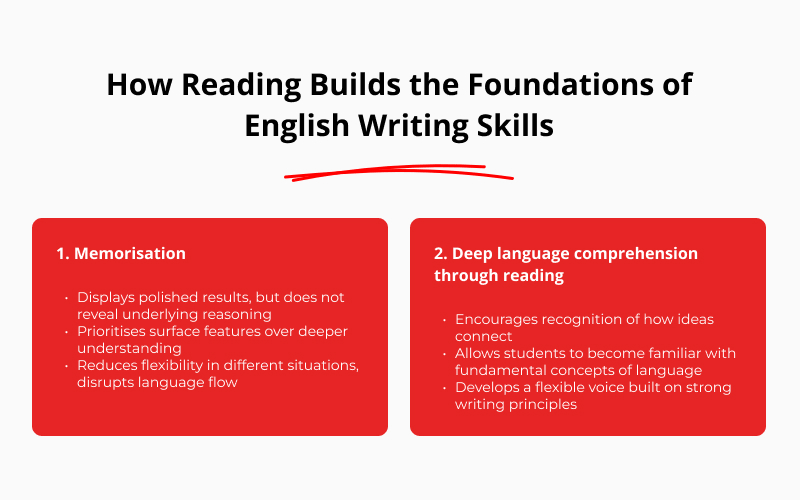
How Reading Builds the Foundations of English Writing Skills
Why Memorised Model Essays Do Not Lead To Meaningful Writing Development
In many Singapore classrooms, model essays are often seen as a practical way to improve results. They offer clear examples of what strong writing looks like and give students a sense of direction. Parents feel reassured because they provide something concrete that children can practise.
However, this clarity can be misleading. At lower levels, model essays provide solutions that may mask true language understanding, leading to later problems.
Model Essays Display Polished Results But Require Complementary Reading Exposure
Model essays show the final version of writing, where ideas are already well-developed and neatly organised. What they do not show is how those ideas were formed in the first place.
Students are not exposed to the thinking behind the writing. They do not see how writers decide what to include, how to expand a point, or how to connect ideas across paragraphs. Without wider reading exposure, students may treat model essays as something to copy rather than something to understand.
This creates a gap. Students can recognise good writing, but may not know how to produce it independently. As a result, English writing skills may improve in familiar situations, but weaken when students face new or unfamiliar topics.
Memorisation Prioritises Surface Features Over Internal Language Understanding
When students memorise essays, they often focus on what is easiest to remember. This includes phrases, sentence structures, and paragraph formats.
While this may help them produce more polished sentences, it does not always reflect real understanding. Students may use advanced vocabulary correctly, yet struggle to adapt it when the context changes.
This is because memorisation focuses on surface features, not on how language works. Writing becomes an act of recall rather than a process of thinking and expression. Over time, this limits flexibility, which is essential for developing strong English writing skills.
Fixed Templates Reduce Flexibility And Disrupt Natural Flow In Writing
Memorised formats can also make writing feel rigid. Students may try to fit every idea into a fixed structure, even when it does not suit the question.
This often affects writing structure and flow. Ideas may feel forced, transitions may be awkward, and paragraphs may not develop naturally. The writing appears organised, but lacks depth and coherence. More importantly, students may begin to rely on formulas instead of thinking about how best to communicate their ideas. This makes it harder for them to adapt, especially in examinations where questions vary.
These limitations highlight a key point: writing cannot rely on imitation alone. Without a fundamental understanding of language, students remain dependent on external examples, restricting long-term development.
How Sustained Reading Exposure Develops An Internal Sense Of Structure
If memorisation builds from the outside, reading develops from within. Through consistent reading, students are not only exposed to words, but also repeatedly see how ideas are organised and expressed. This supports the development of English writing skills in a way that is gradual and lasting.
Reading Repeatedly Exposes Students To How Ideas Are Introduced And Expanded
Every well-written text shows how ideas develop: writers introduce a point, explain it, and support it with examples. As students read regularly, they begin to notice these patterns, and see how paragraphs grow from a central idea and how details are added to deepen meaning.
This repeated exposure supports the internalisation of language. Instead of memorising structures, students begin to understand how ideas naturally unfold. Over time, this shapes how they organise their own writing.
Structural Understanding Forms Through Recognition, Not Explicit Rule-Learning
One of the strengths of reading is that it builds understanding without relying only on rules.
Students do not need to memorise how to structure a paragraph in order to recognise one. Through repeated exposure, these patterns become familiar: they begin to sense what feels clear and well-organised.
This intuitive understanding is what strengthens English writing skills. When students internalise structure, they can organise ideas more naturally. They are no longer dependent on rigid formats because they understand the purpose behind them.
Writing then becomes more flexible: students can adjust how they present ideas based on the question, rather than forcing their responses into a fixed template.
Exposure to Varied Texts Builds Adaptability In Organising Meaning
Reading a range of texts exposes students to different ways of writing. A story may build suspense gradually, while an informational text focuses on clarity and explanation. An argumentative piece may present balanced reasoning, while descriptive writing focuses on detail and imagery.
Through engaging with reading material, students learn that structure is not fixed, but changes depending on purpose. This adaptability is important, especially in examinations. It allows students to respond appropriately to different question types. It also supports deeper language acquisition, as students learn to use language in a variety of contexts.
How Reading Shapes Voice, Flow, and Coherence In Writing
Reading not only builds structure, but shapes how writing sounds and how ideas connect. Voice, flow, and coherence are often difficult to teach directly: they develop through exposure and internalisation over time.
Writing Voice Emerges Through Sustained Exposure to Authentic Language
Voice reflects how naturally a student uses language. Through reading, students are exposed to different tones, styles, and ways of expressing ideas, and begin to recognise how language can be used clearly and effectively.
Over time, this supports independent learning, as students move away from memorised phrases and begin to express ideas in their own words. As a result, their writing sounds more natural and less forced, a key indicator of developing English writing skills. Students also develop greater flexibility in their writing.
Flow Develops As Students Become Familiar With How Ideas Connect
Flow refers to how smoothly writing moves from one idea to the next.
Students who struggle with flow often write in separate pieces. Each sentence may make sense, but the overall writing feels disconnected. Reading helps address this: it shows how writers link ideas, build on previous points, and guide the reader through the text.
With repeated exposure, students begin to apply these patterns in their own work. Writing improves because students understand how ideas should connect, not because they are following a rule.
Coherence Reflects An Internalised Awareness Of The Reader’s Experience
Coherence is about clarity from the reader’s perspective. Strong English writing skills, apart from expressing ideas, also make those ideas easy to follow.
Through reading, students experience what clear writing feels like. They notice when ideas are well-organised, and when they are presented in a confusing way. This awareness helps them improve their own writing: they learn to sequence ideas logically, provide enough explanation, and maintain clarity throughout.
Over time, coherence becomes an internalised skill: it reflects a deeper understanding of how meaning is communicated, which is central to strong English writing skills.

From Exposure to Internalisation: Why Guidance Makes a Difference
By this point, it is clear that reading plays a central role in developing English writing skills. However, not all reading leads to meaningful improvement.
Some students read regularly but continue to struggle with writing; others show steady progress with less volume but more focused support. The difference often lies in how reading is approached. To understand this, it is important to look at how reading moves from simple exposure to true internalisation.
Why Not All Reading Contributes Equally To Writing Development
The Importance Of Text Selection In Shaping Language Growth
The type of material a student reads has a direct impact on their language development.
Some texts offer rich vocabulary, clear organisation, and well-developed ideas. Others may be simpler or less structured. For writing development, exposure to well-crafted texts is important because they provide stronger models of how ideas are built and connected.
At the same time, the level of difficulty matters. If a text is too challenging, students may focus only on understanding the content. If it is too simple, there may be limited opportunity for growth. Careful selection supports the development of language skills by ensuring that students are exposed to patterns they can understand and gradually internalise.
Passive Reading Limits How Much Students Absorb From Texts
Reading frequently does not always translate to better writing.
Many students read passively. They follow the story or information, but do not notice how the writing is structured. As a result, important elements such as grammar and organisation may go unnoticed, which weakens the connection between reading and writing.
What makes a difference is text engagement: when students begin to notice how ideas are organised and developed, reading becomes more meaningful for writing growth.
Discussion Supports Deeper Language Understanding Patterns
Discussion helps students process what they read more actively.
When students talk about a text, they begin to explain ideas in their own words: they reflect on how the writing is organised and why certain parts are effective. This makes patterns more visible, and students begin to understand them instead of simply recognising them. What students notice through discussion becomes something they can apply in their own writing.
How Guided Reading Bridges The Gap Between Reading And Writing
Independent reading is valuable, but guidance helps students focus on what matters most. Without guidance, students may overlook key English writing skills, including text structure: when guided, they learn to see how texts work as complete pieces.
Guided Engagement Helps Students Notice How Texts Function As A Whole
Students often focus on individual sentences or vocabulary. While useful, this can limit their understanding of the overall structure.
Guided reading shifts students’ attention, and they begin to see how introductions set direction, how paragraphs are connected, and how conclusions bring ideas together. This broader view supports stronger English writing skills. Students learn to organise their own writing with greater clarity and purpose.
Writing Development Progresses From Recognition To Internal Application
Writing development happens in stages:
First, students recognise patterns in what they read. They begin to notice how ideas are introduced and developed. With continued exposure, they become more aware of these patterns and can explain why certain writing works well.
Eventually, these patterns become internalised, and students start applying them naturally in their own writing. This is where real improvement happens: writing becomes more flexible because it is based on understanding, not memorisation.
Consistency Supports Sustainable Language Growth
Consistency is key to language development. English writing skills improve through repeated exposure, not occasional practice, and regular reading allows patterns to be reinforced over time. Our Secondary English tuition classes provide opportunities for students to regularly practice their English writing and critical thinking skills.
Without consistency, students may rely on short-term strategies such as memorisation, which may help temporarily but do not support lasting improvement. With consistent exposure and engagement, writing becomes more natural and confident.
How Parents Can Support English Writing Development Through Reading, Not Memorisation
Parents play an important role in shaping how children approach reading. While schools provide structure, the home environment influences habits, attitudes, and long-term engagement.
Why The Home Reading Environment Influences Writing Development
Children develop language skills both in class and at home. When reading is part of daily life, it becomes a source of ideas and expression, which supports language understanding over time.
If reading is treated mainly as a task, students may focus on finishing rather than understanding, which limits its impact on writing. A supportive environment encourages curiosity and engagement, both of which are important for developing English writing skills.
How Parent Attitudes Towards Reading Shape Internalisation
Children often reflect how adults approach reading. When parents show interest, ask questions, and discuss ideas, reading becomes more engaging, which encourages deeper learning. If reading is framed mainly around exams or memorisation, students may approach it mechanically.
Parental support in literacy does not require technical knowledge, but crucially encourages conversation, curiosity, and reflection.
Why Discussion Matters More Than Correction At Home
Correction is often seen as the main way to improve writing, but discussion can be more effective. When parents talk about what their children read, they help them think about how ideas are presented, which supports understanding of structure and flow.
Discussion also reduces pressure: children can explore ideas without worrying about being wrong, which supports confidence and learning. Encouraging conversations about reading also promotes a love of reading outside the classroom, which develops their cognitive skills.
How Consistency At Home Complements Structured Guidance Elsewhere
Consistency across environments makes a difference. When both home and school emphasise reading as a source of language exposure, students receive a clear message about how writing develops. Tuition centres in Singapore, such as Simply Education, help to create consistent study plans for individual students and groups.
Parents do not need to replicate lessons: simple habits such as regular reading and conversation are enough to reinforce learning. This consistency supports the internalisation of fundamental literacy principles, which underpins strong English writing skills.
How Simply Education Supports English Writing Development Through Structured Exposure
We approach English writing skills as the result of a developmental process shaped by reading and internalisation.
Students are introduced to carefully selected texts that match their level. This ensures that reading is both manageable and challenging. Guided discussion helps students notice how ideas are organised, how flow is maintained, and how meaning is developed. This strengthens engagement without making reading feel technical.
Writing is then introduced as an extension of reading. As students internalise language patterns, they begin to apply them naturally in their own work. Over time, this supports steady progress: students develop a consistent narrative voice in a way that is flexible and sustainable, rather than dependent on memorised models. For students facing major examinations, such as those in O-Level English tuition, this becomes particularly important as writing demands increase in complexity.

Frequently Asked Questions
How does Simply Education’s approach differ from centres that rely heavily on model essays?
Simply Education approaches English writing development as a process that grows from sustained reading exposure rather than the replication of polished examples. Instead of treating model essays as templates to memorise, students are guided to engage with a range of texts so they can internalise how ideas are developed, organised, and expressed. This allows writing to emerge from a deeper understanding of language use, rather than surface imitation. Our Primary English classes provide a strong foundation for students to develop their language skills independently.
Will students still practise writing at Simply Education?
Writing remains an important part of the learning process at Simply Education, but it is framed as a natural extension of reading and comprehension rather than a standalone mechanical task. As students become more familiar with how language works through reading, writing becomes a way for them to express ideas using structures and patterns they have already internalised. This supports the development of English writing skills over time.
Is this approach suitable for students who already struggle with writing?
This approach is particularly relevant for students who find writing difficult, as it focuses on rebuilding the underlying language foundations that writing depends on. When students struggle, the issue is often not effort but limited internal exposure to how language is organised and developed. By strengthening this internal framework through guided reading, students are better supported in developing writing confidence gradually and sustainably.
Conclusion
English writing skills develop through sustained exposure, internalisation, and progression. They are not built through memorisation alone.
Reading plays a central role in this process. Through consistent reading and understanding, students absorb how language works, shaping their ability to organise ideas, maintain flow, and communicate effectively.
For parents in Singapore preparing their children for major English examinations, this perspective offers a more sustainable approach. Instead of focusing solely on model essays, supporting reading habits and meaningful engagement with texts can have a deeper and longer-lasting impact.
Simply Education supports this developmental journey through structured reading environments and guided engagement. By focusing on how language is internalised rather than memorised, students are better equipped to write with clarity, flexibility, and confidence.
If you would like to better understand how your child’s reading habits are influencing their English writing skills, or explore how a structured, reading-centred approach can support their progress, Simply Education offers opportunities to discuss your child’s learning needs and next steps. Contact us for more information.