

Why “Asking Better Questions” Is an Overlooked Learning Skill in Singapore’s Academic Landscape
In Singapore’s education system, academic progress is often measured through syllabus completion, assessment performance, and examination outcomes. While these benchmarks are important, they can unintentionally place less emphasis on the learning behaviours that support deep understanding.
Students may appear engaged during lessons and complete their work consistently, yet still face difficulty when applying concepts to unfamiliar questions. This often becomes more noticeable as subjects increase in complexity and require stronger reasoning across topics.
Parents may observe that despite regular study, their child struggles to explain concepts clearly or adapt their understanding. This suggests that effort alone is not always translating into clarity, especially when students are unsure which part of their thinking needs adjustment.
At the core of this challenge is a skill that is rarely taught directly. Students need to recognise when their understanding is incomplete and express it in a way that allows it to be addressed effectively. Without this, misunderstandings may persist and affect future learning.
This is where asking better questions becomes essential. It refers to a student’s ability to identify where understanding breaks down, express uncertainty with clarity, and engage actively with the learning process instead of relying solely on memorisation or routine practice.
Although this skill is rarely taught explicitly, it becomes increasingly important as students progress through different stages of education. From primary school to secondary and beyond, concepts become less procedural and more interconnected, requiring students to think more deeply and communicate their thinking more effectively.
When students are unable to articulate what they do not understand, gaps in learning may remain unnoticed until assessments or more advanced topics expose them. Over time, this can affect confidence, performance, and overall engagement with learning.
This article explores why the ability to ask better questions matters, why many students struggle to develop it independently, and how structured tuition environments can support this aspect of learning alongside school education.
Key Takeaways
- Students often recognise confusion but struggle to explain it clearly, and developing better questioning helps them identify specific issues and improve more effectively.
- General statements of not understanding can mask multiple overlapping gaps, and learning to break these down through more precise questioning allows students to focus on what truly requires clarification.
- Structured guidance helps students refine how they approach uncertainty by strengthening their ability to question their own understanding and respond more independently.
- Consistent reinforcement across both learning and home environments supports the development of stronger questioning habits, leading to clearer communication, greater confidence, and more steady academic progress.
Understanding the Role of Questions in Learning
Before students can improve how they ask questions, it is important to understand the role that questioning plays in learning. Questions are not just a way to seek answers, but a tool for identifying gaps, clarifying thinking, and strengthening understanding across subjects and academic levels.
Distinguishing Between General Confusion and Meaningful Academic Questioning
Not all questions reflect the same level of understanding. Some indicate surface-level confusion, while others reveal deeper thinking and awareness of specific learning gaps. Recognising this difference is a key step in helping students move towards more effective learning habits.
Why Statements Like “I Don’t Understand” Often Conceal Deeper Learning Gaps
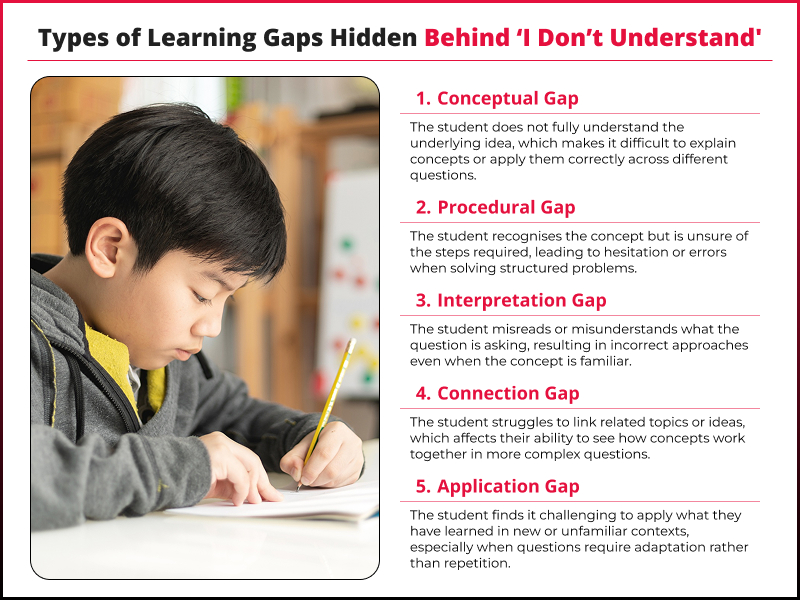
When students say “I don’t understand,” the statement often reflects awareness that something is unclear, but not clarity about what specifically has gone wrong in the learning process. This makes it difficult for teachers or tutors to respond effectively, as the source of confusion is not clearly defined.
In many cases, this form of general confusion arises from multiple overlapping issues, such as a misunderstood concept, an unfamiliar method, or uncertainty about how different ideas connect. Without clear questioning, students may not be able to separate these issues or identify which part requires attention.
Younger and older students alike may lack the academic language needed to describe their confusion precisely, especially in subjects that rely on abstract reasoning, such as Mathematics and Science. This often limits their ability to move from general uncertainty to specific clarification.
As a result, teachers and tutors are often required to infer the source of difficulty. While experienced educators can guide students effectively, this process may still lead to explanations that address only part of the issue rather than the root cause.
Over time, unresolved vagueness can cause students to move forward with partial understanding, which may affect their ability to cope when concepts become more complex. This highlights the importance of asking better questions, which help students identify and address misunderstandings earlier.
Without clearer questioning, students may also struggle to reflect on their own learning. This makes it harder for them to recognise patterns in their mistakes or identify recurring areas of difficulty.
For example, a student working on Algebra may say they do not understand a question when the difficulty actually lies in identifying which formula to apply or interpreting what the question is asking. Without expressing this clearly, the root of the confusion may remain unaddressed.
To make this clearer, the different types of learning gaps behind general confusion can be understood as follows:
What Separates Surface Questions from More Meaningful Academic Questions
More effective questions often show that a student has reflected on what they know and what they do not know, rather than simply expressing frustration. This shift is an important step towards developing independence in learning.
These questions tend to indicate a specific point of breakdown, such as uncertainty about why a method applies, how a concept works, or what a question is asking for. In this way, asking better questions supports clearer communication and more targeted support.
Rather than seeking immediate answers, clearer questions provide insight into the student’s thinking process. This allows explanations to be more focused, which can improve understanding within a shorter period of time.
The value of such questions lies in their ability to clarify understanding efficiently, reducing the need for repeated explanations or excessive practice. Over time, students who develop this skill are better able to engage with new material independently.
This shift from general uncertainty to specific clarification strengthens conceptual understanding and reduces reliance on rote learning strategies, particularly in subjects that require reasoning and application.
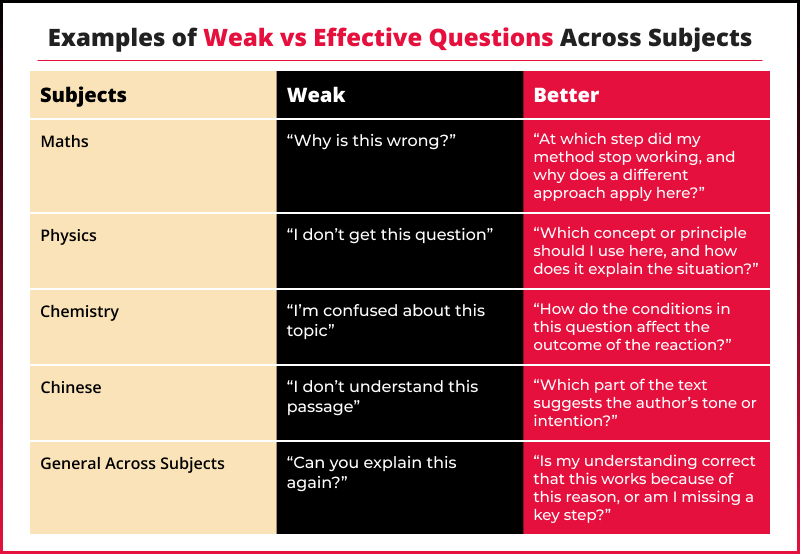
The difference becomes clearer when we compare how questions are typically phrased across subjects:
Why Many Students Struggle to Form Meaningful Questions
While the importance of asking clear and specific questions is evident, many students still find it difficult to do so consistently. This challenge is not simply a matter of effort, but is shaped by how students process information, the learning environments they are in, and the habits they develop over time.
Cognitive Constraints That Affect How Students Process and Express Confusion
In subjects like Mathematics, Physics, and Chemistry, students are required to work with abstract ideas, symbolic representations, and specialised terminology. These demands can make it challenging to process new information while also identifying what is unclear.
When students are still trying to grasp new content, they may struggle to reflect on what they do not understand at the same time. This makes it difficult to form clear questions during lessons, even when confusion is present.
Limited familiarity with subject-specific language can further restrict a student’s ability to describe uncertainty. Without the vocabulary to explain what is unclear, students may recognise confusion but be unable to express it effectively.
As a result, confusion may only become apparent after the lesson, when students attempt homework or revision independently. By then, the opportunity for immediate clarification has already passed.
This delay can cause misunderstandings to persist longer than necessary, especially when new topics build directly on earlier concepts. Learning gaps may gradually widen if they are not addressed early.
In structured Singapore environments, such as a tuition centre, students are often guided to break down their confusion step-by-step, which helps them express their uncertainties more clearly over time.
Classroom Factors That Shape How Students Ask Questions in School
In most classrooms, lessons are organised within fixed time blocks to ensure topics are covered within the school term. While this structure supports curriculum completion, it can limit opportunities for extended clarification during a single lesson.
Teachers often manage classes with students progressing at different learning speeds. This makes it difficult to pause frequently without affecting the overall flow of the lesson, especially in larger classes.
Within these conditions, students may come to view questions as something to raise only when confusion feels obvious or urgent, rather than as part of ongoing understanding. This can discourage regular clarification.
Classroom social dynamics can also influence participation. Some students may worry about drawing attention to themselves or slowing down the lesson, which reduces their willingness to speak up.
Over time, these everyday classroom realities can encourage reliance on model answers and repeated practice instead of active clarification during lessons. This pattern can limit opportunities for asking better questions in real time.
While such structures support smooth lesson delivery, they may offer limited space for students to pause, reflect, and articulate uncertainty. This highlights the importance of environments that actively encourage asking better questions as part of learning.
Habitual Learning Patterns That Reduce Active Inquiry
Repeated exposure to worked examples and standardised question formats can encourage students to focus on replicating steps rather than understanding underlying reasoning. While this may produce short-term results, it does not always support deeper learning.
Over time, this approach can limit opportunities for students to question why certain methods work or when they should be applied. Without this reflection, learning may remain procedural rather than conceptual.
Passive learning habits formed early can persist into later years. Students may begin to expect explanations to be provided, rather than actively seeking clarity through asking better questions.
Without regular practice, students may struggle to develop the awareness and language needed to identify and address the nature of confusion in their own learning. This can make learning feel more effortful as academic demands increase.
Developing confidence in articulating uncertainty allows students to engage more actively with concepts and respond more effectively when challenges arise.
Why Asking Better Questions Becomes Increasingly Important as Students Progress
As students move through different academic stages, the nature of learning shifts from following familiar steps to engaging with more complex and interconnected ideas. In this context, the ability to identify gaps early and express them clearly becomes increasingly important for maintaining understanding, confidence, and consistent academic progress.
Rising Conceptual Demands Across Academic Stages
As students move from upper primary to secondary school, learning shifts from concrete procedures to more abstract reasoning. This requires stronger internal coherence and a deeper understanding of how concepts connect.
Topics become more interconnected, making it harder to rely on isolated memorisation without understanding underlying relationships. Students are expected to apply knowledge across different contexts.
At upper secondary and junior college levels, students are required to justify methods, explain reasoning, and apply concepts in unfamiliar situations. These demands make asking better questions an essential skill for academic progress.
In these stages, the ability to recognise and articulate confusion becomes critical, as gaps in understanding are less likely to be resolved through repetition alone.
Students who cannot clarify their uncertainties early may find that misunderstandings accumulate over time, affecting confidence and consistency in performance.
In subjects such as Maths or Science, structured guidance can help students identify specific gaps and practise asking better questions in a focused and supportive setting.
What “Better Questions” Look Like as Students Progress
At more advanced stages, effective questions tend to reflect a clearer awareness of where understanding breaks down, rather than a general sense of confusion. This signals stronger engagement with the learning process.
Instead of asking broad questions such as “Why is this wrong?”, students begin to express more precise uncertainties. For example, they may question assumptions, relationships, or conditions within a problem.
These questions often reveal whether a student is struggling with interpretation, conceptual linkage, or application. This allows gaps to be addressed before they become more significant.
As academic demands increase, the quality of questions becomes a key indicator of learning maturity. Students who practise asking better questions are often better equipped to engage with complexity and adapt to new problem types.
Subject-Specific Consequences of Weak Questioning Skills
When students are unable to express their uncertainties clearly, the impact often becomes more visible within specific subjects. Each subject places different demands on understanding and application, which means that weak questioning skills can affect performance in distinct and practical ways.
Maths
Students may apply methods mechanically without understanding why they are appropriate, which can lead to difficulty when questions deviate from familiar formats. This is a common issue observed in exam settings.
Misinterpretation of problem conditions or assumptions often goes unnoticed without active questioning. Students may complete similar-looking questions correctly but struggle when variation is introduced.
For example, a student may know how to solve a standard algebra question but feel uncertain when deciding which method applies in a multi-step problem. In Maths tuition, students are guided to examine these decision points more closely, which supports asking better questions about why a method applies in a given context.
Physics
Formulae may be used without a clear grasp of the underlying physical principles, resulting in confusion when scenarios change. This limits a student’s ability to transfer knowledge across topics.
Weak questioning reduces the ability to connect concepts across different areas, which is essential in Physics, where topics are highly interrelated.
This often appears when students can substitute values into equations but are unsure why a formula applies in one situation and not another. With consistent support, such as through Science tuition at the secondary level, students can learn to identify these gaps more precisely.
Chemistry
Confusion between processes, conditions, and outcomes can persist when students do not clarify how reactions and concepts relate. This affects both theoretical understanding and application.
Data-based and application questions become challenging without a strong conceptual framework. Students may rely on memorisation but struggle to adapt when conditions change.
Students may remember reaction pathways yet remain unclear about how changes in conditions affect outcomes. Developing the habit of asking better questions helps them build clearer connections between concepts. In Science tuition in Singapore, students are guided to examine how and why these changes occur, which supports a deeper and more flexible understanding of Chemistry.
Chinese
Students may struggle to express uncertainty around inference, tone, or nuance, particularly in comprehension and oral components. This can affect both understanding and performance.
A lack of precise questioning can hinder deeper language understanding beyond surface meaning. Students may recognise difficulty but be unable to identify its source.
Instead of identifying whether the issue lies in vocabulary, inference, or interpretation, students may experience repeated confusion across passages. In more focused support settings such as Chinese tuition in Tiong Bahru, students are often guided to break down these challenges and practise expressing their uncertainties more clearly.
How Structured Tuition Environments Support Better Questioning
As students progress academically, the ability to ask clear and purposeful questions becomes increasingly important for deeper understanding and independent learning. This skill strengthens when students learn to practise asking better questions in a more intentional and structured way. However, it does not always develop consistently without the right support. Structured tuition environments provide the guidance, space, and feedback needed for students to recognise uncertainty, express it clearly, and refine their thinking over time. The following sections explain how this process is supported in practice.
Why Questioning Skills Rarely Develop Consistently Without Guided Support
Questioning ability is often assumed to develop naturally as students mature. However, many students progress academically without refining how they seek clarification. Without explicit guidance, they may not recognise gaps in their understanding or know how to express uncertainty clearly, which limits their ability to improve meaningfully.
In the absence of structured support, students often compensate for confusion by memorising procedures or relying on repeated practice. While this can produce short-term results, it does not build the reasoning needed to handle unfamiliar or more complex questions. As academic demands increase, this gap becomes more evident.
Structured guidance creates opportunities for students to reflect on their thinking and explain what they do not understand clearly in a supportive setting. Over time, this helps them distinguish between different types of confusion and respond more effectively. As a result, students develop stronger clarity and are better equipped to approach new problems with confidence.
How Tuition Settings Create Conditions for Thoughtful Clarification
Structured tuition environments are intentionally designed to support how students think, not just what they produce. This creates the conditions needed for students to slow down, reflect, and engage more actively with areas they do not yet fully understand.
Structural Features That Support Reflection
The way a learning environment is structured directly affects how comfortable students feel revisiting uncertainty. In smaller group settings, tutors can observe how students approach problems, making it easier to identify misconceptions early and guide clearer reasoning.
Reduced class sizes also lower the pressure to keep pace with a larger cohort. Students are given the space to pause, reflect, and revisit concepts without feeling rushed. Flexible pacing further supports this by allowing key ideas to be reinforced until understanding is secure, rather than moving on with unresolved confusion. Together, these conditions help shift learning from task completion to meaningful understanding.
Learning Interactions That Refine Thinking Over Time
Beyond structure, the quality of interaction plays a critical role in shaping how students develop questioning skills. Through clarification-focused dialogue, students are encouraged to express partial understanding instead of waiting for complete answers, which builds confidence in sharing their thinking.
Tutors can then identify and clarify the source of confusion, whether conceptual or procedural, before misconceptions become entrenched. Over time, repeated exposure to this process helps students improve how they frame questions and engage with new material more independently. This becomes especially important in more demanding academic stages, where students are expected to apply knowledge with greater flexibility and clarity.
How Simply Education Supports the Development of Better Questioning Skills
At Simply Education, lessons are designed to prioritise structured understanding across subjects such as Maths, Physics, Chemistry, and Chinese. Rather than focusing on rote repetition, the approach centres on helping students recognise where they need clarification and how to address it effectively.
Students are consistently guided to articulate uncertainty and refine their thinking through purposeful questioning. This not only strengthens their understanding of individual topics but also builds awareness of their own learning process. As students become more confident in expressing what they do not understand, they are better able to engage with increasingly complex material.
This approach is especially valuable in secondary tuition, where students are expected to manage more abstract concepts and multi-step problem-solving. By reinforcing understanding before progression, Simply Education helps students develop clarity, independence, and stronger long-term learning habits.
How Parents Can Encourage Better Questions at Home

The home environment plays an important role in shaping how comfortable students feel about acknowledging uncertainty. When conversations focus mainly on whether answers are correct, students may become less inclined to reflect on what they do not understand. Shifting the focus towards how they arrived at an answer helps reinforce that thinking processes matter and encourages students to practise asking better questions.
Simple changes in how parents engage with their children can make a meaningful difference. When uncertainty is treated as a normal part of learning rather than something to be avoided, students are more likely to express it openly. This creates opportunities for them to clarify their thinking instead of relying on guesswork or silence.
Providing space for children to explain their reasoning, even when it is incomplete, supports the development of clearer expression over time. For instance, instead of asking whether an answer is correct, parents can ask how their child approached the question and what they found challenging. When this is reinforced consistently, students begin to see questioning as a natural and valuable part of learning.
Consistency between home and structured learning environments further strengthens this habit. When students experience similar expectations across settings, they are more likely to internalise questioning as part of how they learn. This alignment supports steadier academic progress as subjects become more demanding.
Questions You Might Ask
1. Is asking better questions something my child can realistically develop?
Asking better questions is not an innate trait that some students have and others lack. It develops as students become more aware of how they understand concepts and where that understanding breaks down. When students are supported in articulating uncertainty clearly rather than masking it with general confusion, this skill strengthens over time. In structured learning environments such as Simply Education, students are given opportunities to reflect on their thinking and express gaps in understanding in a guided, supportive way, allowing questioning skills to mature alongside academic progress.
2. What if my child is quiet and rarely speaks up?
Effective questioning is not determined by how often a student speaks, but by how clearly they can express uncertainty when it arises. Many quieter students process information internally and may struggle to verbalise confusion in fast-paced or high-pressure settings. Smaller, more focused learning environments can reduce this pressure, making it easier for students to organise their thoughts and clarify what they do not understand. Over time, this supports clearer articulation without requiring students to become outspoken or extroverted.
3. Does this skill matter for analytical subjects like Maths and Science?
In subjects such as Maths, Physics, and Chemistry, understanding depends heavily on recognising why methods work and how concepts connect, rather than memorising steps alone. When students can ask more precise questions, they are better able to clarify assumptions, interpret problem conditions, and resolve conceptual gaps early. As these subjects become more complex, the ability to question meaningfully supports deeper understanding and reduces reliance on rote learning.
4. Will stronger questioning skills support long-term academic progress?
Students who can recognise and articulate confusion early are less likely to carry unresolved gaps forward as academic demands increase. Clearer questioning allows misunderstandings to be addressed before they compound, supporting steadier progress across levels. Over time, this contributes to a more consistent understanding, greater independence in learning, and reduced frustration when encountering unfamiliar or challenging material.
5. How does this differ from simply asking more questions in class?
Asking better questions is not about increasing the number of questions a student asks, but about improving the quality and clarity of those questions. A single well-articulated question that pinpoints a specific area of confusion is often more effective than multiple broad or unfocused queries. This distinction helps students engage more productively with explanations and develop a clearer grasp of concepts without feeling overwhelmed or dependent on constant clarification.
Conclusion

Asking better questions enables students to engage more deeply with learning, moving beyond surface strategies such as memorisation or repeated practice, and towards a clearer understanding of how concepts work and connect. When students develop this habit consistently, they become more aware of their own thinking and are better able to respond to challenges with clarity and purpose.
As academic demands increase and subjects become more interconnected, the ability to practise asking better questions grows in importance. It allows students to identify and address gaps in understanding early, before they compound over time. This leads to more efficient learning and greater confidence when approaching unfamiliar or complex questions.
Structured tuition plays a complementary role alongside school education by creating space for reflection, clarification, and guided thinking. With the right support, students are able to strengthen their reasoning, refine their understanding, and build more consistent learning habits across subjects.
Simply Education supports students in developing clearer thinking habits across Maths, Science, and Chinese. Through a structured and student-centred approach, students are guided to recognise uncertainty, express it clearly, and improve how they engage with their learning over time.
For parents who want to better understand how their child approaches learning, speaking with an experienced educator can provide useful clarity. At Simply Education, lessons are structured to help students recognise where their understanding breaks down and develop clearer, more effective ways of thinking. Contact us to discuss your child’s learning needs and how structured support can help them build a clearer understanding, improve problem-solving accuracy, and gain confidence across subjects.